
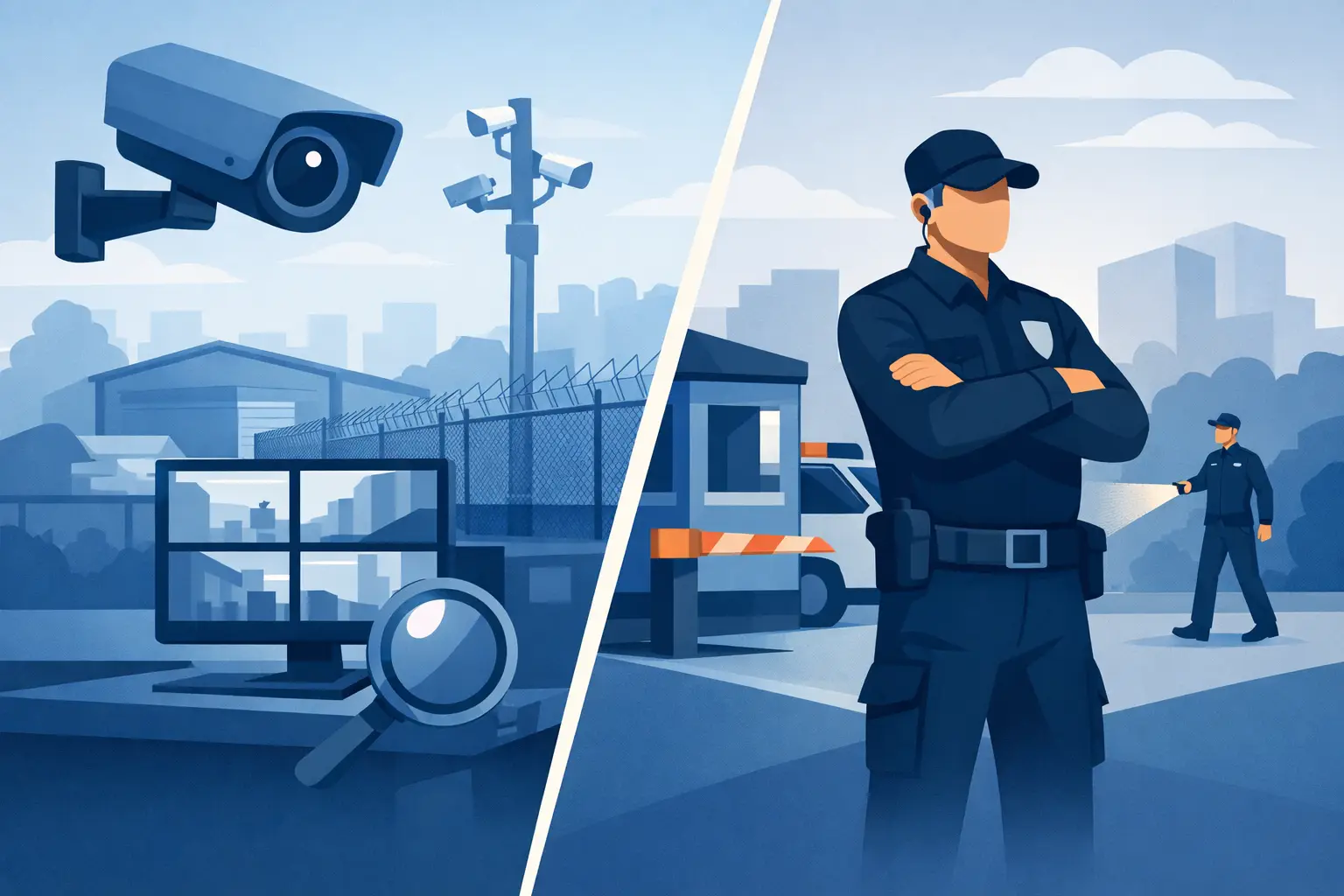
A camera can record an incident in clear detail, but it cannot challenge an intruder at a gate, calm a confrontation in reception or direct emergency services to the right part of a large site. That distinction sits at the heart of CCTV versus manned guarding. For UK organisations, the right choice is rarely about selecting the cheapest option. It is about matching protection to the risks that could interrupt operations, endanger people or expose valuable assets.
CCTV and security officers both have a valuable role. Their strengths, limitations and costs are different, which is why a site-specific assessment should come before a decision. A distribution yard with occasional out-of-hours trespass has different requirements from a busy retail store, a vacant property or a construction project with changing access points.
CCTV versus manned guarding: the practical difference
CCTV provides observation. Depending on the system, it may record activity, send alerts when motion is detected and allow footage to be reviewed after an event. Monitored CCTV can also bring a human operator into the process, enabling warnings or escalation where suspicious activity is seen.
Manned guarding provides physical presence, judgement and action. A trained officer can check identification, manage visitors, patrol vulnerable areas, respond to alarms, preserve a safe scene and report concerns before they become incidents. They can also carry out duties that fall outside a camera’s capability, from opening and locking premises to assisting staff and supporting emergency procedures.
The question is therefore not whether cameras are useful. They often are. The question is whether observation alone provides an acceptable level of protection when something happens.
Where CCTV is the right fit
CCTV can be a cost-effective foundation for sites where the primary need is visibility over defined areas. Entrances, perimeter lines, loading bays, car parks and stock areas can all benefit from a well-positioned system. Recorded footage may assist investigations, support insurance claims and identify patterns such as repeated unauthorised access or vulnerable delivery times.
It is particularly useful when a site is unoccupied for long periods but the risk level is relatively controlled. Cameras can extend oversight across areas that would be difficult for one officer to watch continuously. They may also reduce the number of patrols required when paired with alarm response or mobile patrol services.
However, CCTV performance depends on design and management. Poor camera placement creates blind spots. Inadequate lighting can reduce image quality. A camera that records but is not monitored may only reveal a theft after the loss has occurred. Even advanced analytics can generate false alerts from weather, wildlife, moving shadows or routine site activity.
For low-risk environments, these limitations may be acceptable. For sites holding high-value materials, sensitive data, hazardous equipment or vulnerable people, they can leave too much time between detection and response.
What manned guarding adds
A uniformed security presence is a visible deterrent. People considering trespass, theft or disorder are less likely to act when they know a trained professional is actively controlling the premises. This is especially relevant for retail environments, construction sites, corporate buildings and events where risks can develop quickly and in public view.
More importantly, officers make informed decisions in real time. A guard can distinguish a contractor who has arrived at the wrong entrance from someone attempting to gain unauthorised access. They can identify an unsecured fire door, challenge unfamiliar behaviour, intervene within their training and escalate to the appropriate emergency service when needed.
Manned guarding also supports day-to-day operations. Officers can manage gatehouses, issue visitor passes, maintain access records, check deliveries, monitor keys and conduct opening or closing procedures. At events, they can support queue management, customer reassurance and incident reporting. On construction sites, they can check perimeter integrity and respond to issues caused by changing layouts, deliveries and workforce movements.
This human judgement is the main advantage of guarding, but it must be properly managed. A guard should not be treated as a static figure at a desk. Effective coverage requires clear assignment instructions, communication procedures, supervisory support and a deployment plan based on the site’s actual threat level.
Response time is often the deciding factor
When comparing CCTV versus manned guarding, decision-makers should focus on what happens after suspicious activity is detected. A camera may capture someone cutting through a fence. A monitored system may identify the incident and notify a keyholder, mobile patrol or police control room. Each step takes time, and the outcome depends on who can attend and how quickly.
An on-site officer can assess the situation immediately. They may secure an access point, keep staff away from danger, challenge an individual where appropriate and provide accurate information to police or emergency responders. The benefit is not merely speed. It is the ability to take proportionate action while maintaining a record of events.
That does not mean every site needs a full-time guard. A managed approach may use mobile patrols for scheduled and random visits, with CCTV supporting wider visibility between attendance times. For higher-risk periods, such as overnight works, stock deliveries or public events, temporary manned cover may be the sensible addition.
Cost should be measured against exposure
CCTV can appear less expensive because installation and monitoring costs are often easier to forecast than ongoing staffed coverage. Yet the lowest monthly figure is not always the lowest business risk. A single theft, interrupted construction programme, violent incident or breach of access controls can create losses that exceed the apparent saving.
Manned guarding has a higher direct cost because it involves trained personnel, supervision and continuous operational management. In return, organisations receive a responsive presence that can carry out multiple protective and practical duties throughout a shift.
The most cost-effective answer is often proportionate rather than absolute. A warehouse may need CCTV across the full perimeter, mobile patrol checks overnight and a gatehouse officer during busy delivery windows. A corporate office may use access-controlled CCTV after hours but require a concierge-style security officer during the working day. A retailer may need officers at peak trading times, supported by cameras that help identify repeat loss-prevention concerns.
Before setting a budget, consider the value of the assets at risk, the likely impact of disruption, previous incidents, the size and layout of the site, public access, lone-worker exposure and any contractual or insurance requirements. These factors provide a more useful basis for investment than a simple comparison of hourly guarding rates against camera installation costs.
Security works best as a layered plan
CCTV and manned guarding should not be viewed as opposing choices in every circumstance. Cameras give officers better situational awareness, help verify incidents and support post-incident reporting. Officers give CCTV a response capability, identify faults such as obscured lenses and act on concerns that technology cannot interpret reliably.
A layered security plan may also include access control, alarm systems, perimeter measures, lighting, keyholding and mobile patrols. The goal is to make unauthorised activity harder to attempt, easier to detect and faster to address. The exact combination should reflect the operating hours, local environment, asset value and nature of the people using the premises.
For example, a vacant commercial property may require temporary cameras and regular patrols to deter trespass and identify damage early. A live construction site may benefit from perimeter CCTV, controlled gate access and overnight officers during phases where plant and materials are particularly exposed. An office with regular visitors may need front-of-house guarding that combines access control with a professional welcome.
How to make the right decision for your site
Start with the incidents that would cause the greatest harm. Is the primary concern theft, unauthorised access, anti-social behaviour, staff safety, fire risk, public disorder or operational interruption? Then examine when and where that risk occurs. A security plan that is effective at midnight may be unsuitable for a busy weekday reception.
Next, assess the response available when an alarm or camera alert is raised. If there is no reliable person able to attend promptly, CCTV alone may provide evidence without preventing loss. If staff are expected to respond, consider whether that places them in an inappropriate or unsafe position.
A professional risk assessment should turn these answers into practical measures: the right patrol frequency, officer responsibilities, camera coverage, escalation routes and reporting arrangements. Hawk Security Group can tailor this approach around the site rather than forcing a standard guarding package onto a complex operation.
The most dependable security decision is the one that gives your people clear support, protects the assets your organisation relies on and provides a credible response when conditions change.