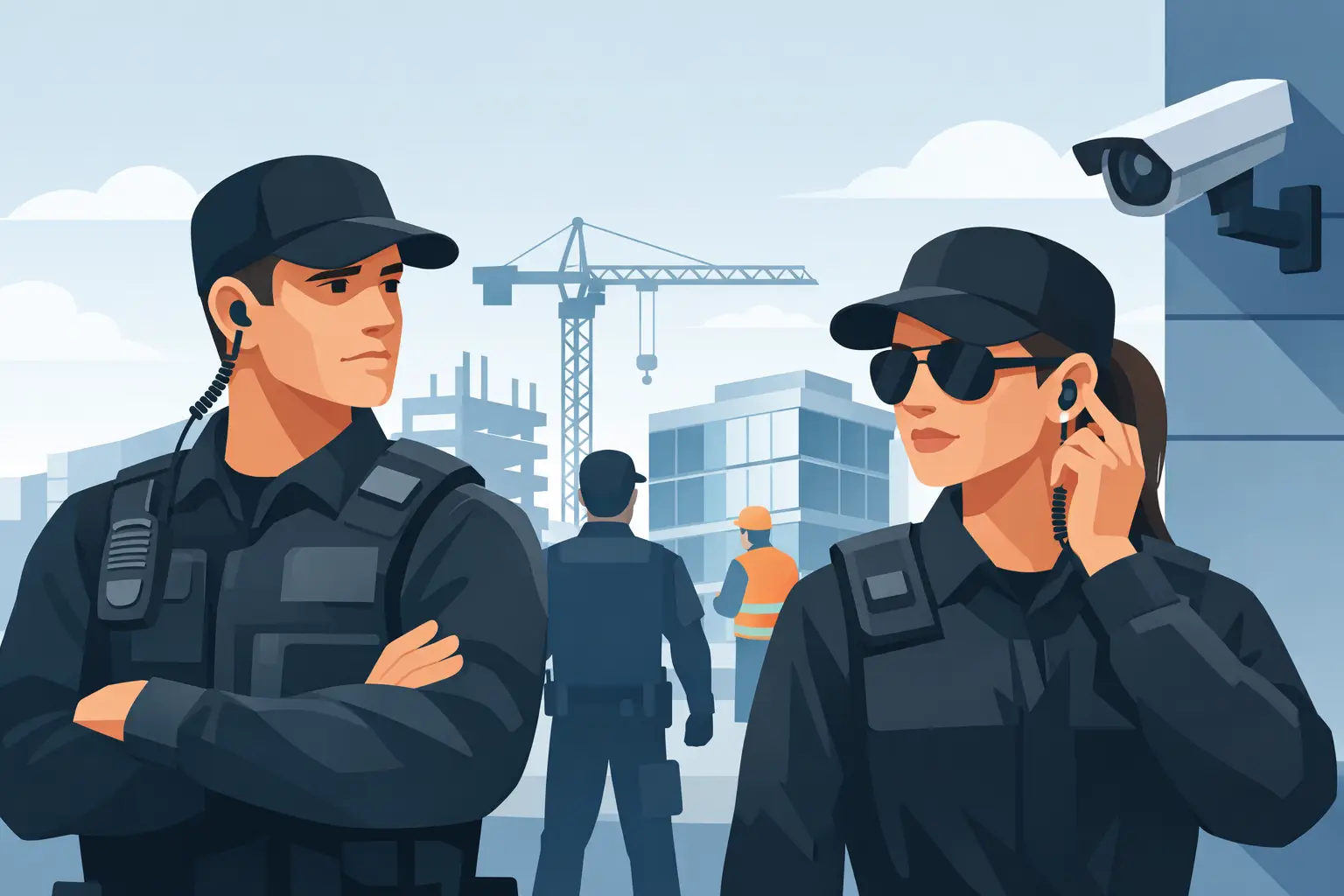
A security incident rarely starts with a dramatic break-in. It may begin with an unsecured side entrance, a visitor who is not challenged, or a contractor arriving outside agreed hours. SIA licensed security guards give organisations a trained, visible and accountable presence to manage these everyday risks before they become costly disruption.
For facilities managers, site managers and operations teams, the question is not simply whether to place a guard at the gate. It is how to deploy the right people, at the right times, with clear instructions that protect staff, visitors, premises and assets without getting in the way of normal business.
What SIA licensed security guards bring to a site
The Security Industry Authority regulates the private security industry in the UK. Where a role involves licensable frontline activity, such as guarding premises against unauthorised access, theft or damage, the operative must hold the appropriate SIA licence. This gives clients assurance that the individual has met the required training and identity standards for that work.
A licence is an essential starting point, but it is not the whole security solution. Effective guarding also depends on site induction, clear assignment instructions, supervision and a practical understanding of the environment being protected. A guard working at a corporate reception needs a different approach from one covering a vacant property, busy retail store or live construction project.
The value of a professional officer is often found in the small operational controls that are carried out consistently. They can check identification, manage visitor and contractor sign-in, monitor access points, complete patrols, record incidents, respond to alarms and report defects such as damaged fencing, failed lighting or unsecured doors. Their presence also provides reassurance to employees and members of the public, particularly during lone-working hours or periods of increased footfall.
Match the guarding plan to the risk
Security cover should follow the real risks on site, not a standard staffing pattern. A single static officer may be appropriate for a low-traffic office with one public entrance. A distribution yard with vehicle movements, perimeter access and high-value stock may need a gatehouse presence, mobile patrols and out-of-hours alarm response. An event venue may need licensed security staff alongside trained stewards, with defined responsibilities for entry, queues, welfare and escalation.
The first step is an on-site risk assessment. This should consider the layout, hours of operation, access routes, asset values, visitor numbers, existing CCTV and alarm systems, recent incidents, and any vulnerable periods. For example, a construction site may be most exposed overnight and at weekends, while retail premises may need greater support at opening, closing and peak trading times.
From there, a tailored deployment plan can set out where officers are positioned, how frequently patrols take place, what is checked, who has authority to enter, and how incidents are escalated. It should also identify the line between security activity and other site responsibilities. Guards can support safe operations, but they should not be expected to take on tasks without suitable training, equipment or authority.
Static guarding and mobile patrols
Static guarding gives a consistent point of contact at a fixed location. It is particularly useful for receptions, gatehouses, loading areas, main entrances and high-risk access points. The officer can monitor arrivals, maintain records and act quickly if an issue develops.
Mobile patrols provide wider coverage across larger or lower-occupancy sites. They can inspect doors, gates, compound boundaries, plant areas and welfare facilities, then report exceptions promptly. Patrols are often a cost-effective option where a full-time static presence is unnecessary, but they are not a substitute for continuous guarding when a location requires immediate on-site intervention.
Many sites benefit from both. A guard at the principal entrance can control access while scheduled and random patrols reduce predictable gaps elsewhere on the premises.
Professional conduct matters as much as visibility
A visible uniform can deter opportunistic crime, but the quality of interaction matters just as much. Security officers are often the first people a visitor meets and the last staff members on site at night. They need to be alert, calm and approachable while following policy consistently.
This balance is especially important in corporate, retail and public-facing settings. An officer should be capable of challenging unauthorised access without creating unnecessary confrontation, giving clear directions to visitors and recognising when an issue requires a manager, emergency service or additional security response.
Clear assignment instructions help make this possible. They should cover access procedures, prohibited items, keys and passes, patrol routes, emergency contacts, reporting requirements, evacuation arrangements and escalation thresholds. Instructions must be specific enough to guide decisions, yet reviewed whenever the site layout, threat level or operations change.
Good communication between the client and security provider is equally important. If a building is hosting a high-profile meeting, receiving an unusual delivery, extending operating hours or carrying out works, the guarding team needs that information before the shift begins. Security is strongest when it is part of operational planning rather than a service called upon only after something has gone wrong.
Checking capability beyond the licence
When appointing a provider, organisations should confirm that officers hold the correct licence for the duties they will perform and that licences are checked throughout the contract. However, procurement decisions should also look beyond this basic requirement.
Ask how the provider recruits, vets and inducts staff; how absences and emergency cover are managed; who supervises the contract; and how incidents are reported to the client. It is also sensible to establish whether the provider can scale cover during busy periods, site moves, major works or events.
The most useful reports are not simply activity logs. They should give decision-makers a clear picture of what has happened, what was found during patrols, what action was taken and whether recurring issues need wider attention. Repeated reports of a faulty gate, for instance, should lead to a repair plan rather than becoming a permanent line in the daily occurrence book.
For nationwide organisations, consistency can be a challenge. A provider with experienced operations management and UK-wide deployment capability can maintain agreed standards while adapting the guard plan to local conditions. Hawk Security Group Ltd. works from this principle: assess the site, understand the operational need and provide trained personnel supported by a defined management structure.
Plan for incidents before they happen
Security officers should have a clear, proportionate response to foreseeable incidents. That includes unauthorised access, theft, aggressive behaviour, alarm activation, fire evacuation, suspicious items, medical emergencies and loss of power or communications. The right response will depend on the site and the immediate risk to people.
A guarding plan should never assume that officers can resolve every situation alone. Their role is to observe, deter, communicate, protect people where it is safe to do so and escalate appropriately. Clear emergency contacts, reliable radios or telephones, and agreed procedures with site management are essential.
It is also worth testing the plan. A tabletop exercise or practical review can expose gaps that are easy to miss on paper: an outdated key list, unclear muster points, poor mobile signal at the rear of the site, or uncertainty about who can authorise access after hours. Addressing these issues early protects business continuity when a real incident occurs.
When more security is not necessarily better
More officers do not automatically mean better protection. Overstaffing a low-risk location can add cost without improving control, while a poorly briefed officer at a critical entrance can leave significant vulnerabilities. The aim is proportionate coverage based on risk, operating hours and the consequences of an incident.
Technology can support this approach. CCTV, access control, intruder alarms and remote monitoring can improve awareness and provide evidence. Yet these systems still need human judgement. A guard can investigate an open door, recognise unusual behaviour, support a distressed visitor and communicate directly with management in ways technology cannot.
The most dependable arrangement combines trained people, practical procedures and appropriate technology. It is reviewed as the site changes, rather than left unchanged because it was suitable when the contract first began.
If your premises, event or project requires visible deterrence and accountable response, start with a site assessment and an honest discussion about the risks you need to manage. The right guarding plan should make everyday operations feel safer, more controlled and easier to run.